
Construction materials can be heavy, brittle, long, moisture-sensitive, or vulnerable to finish damage. Packaging should reflect the product and the full chain of handling, transport, unloading, and storage. Buyers should approve a defined pack and evidence plan instead of leaving protection to a generic supplier promise.
Key takeaways
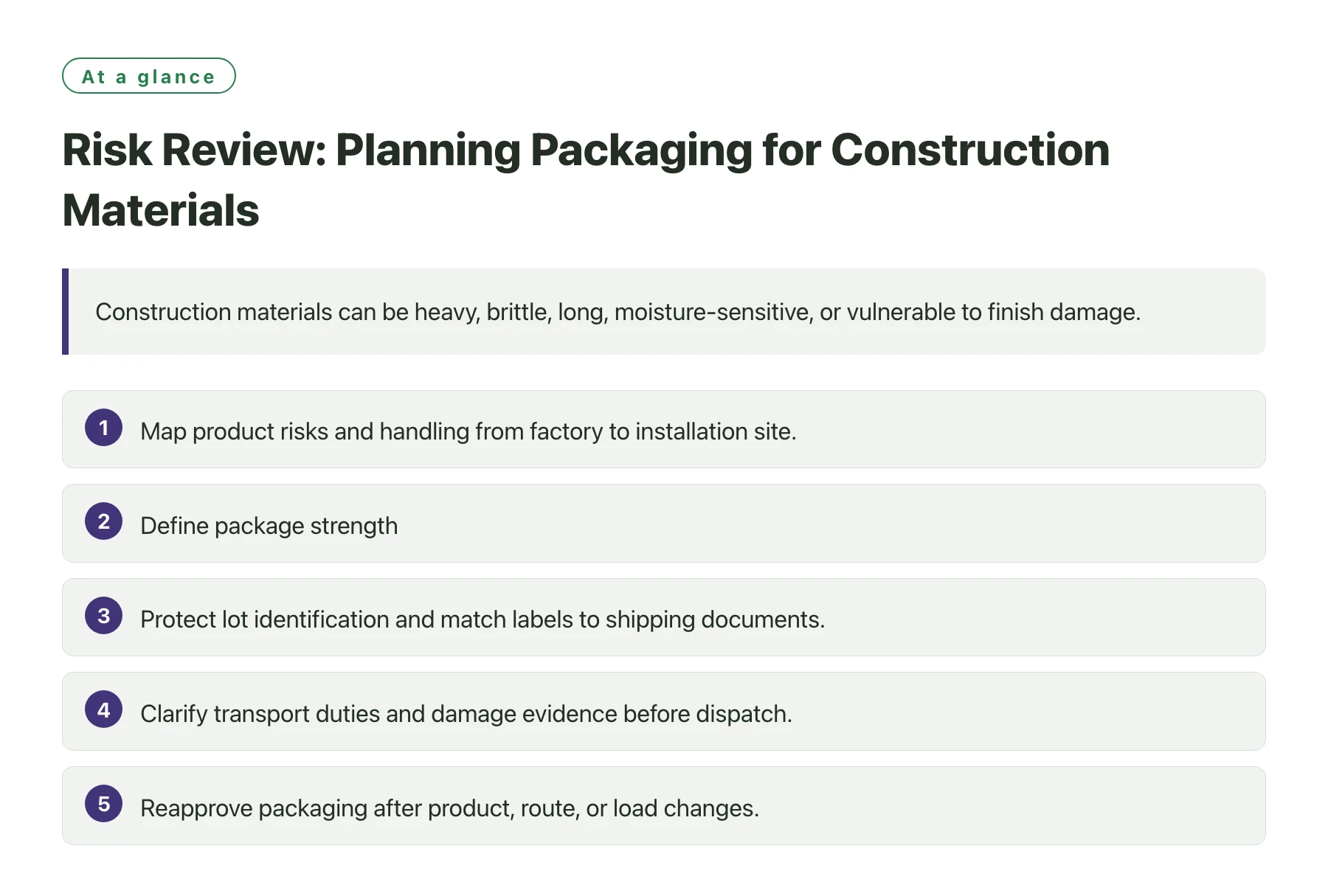
- Map product risks and handling from factory to installation site.
- Define package strength, separation, size, stacking, and lifting details.
- Protect lot identification and match labels to shipping documents.
- Clarify transport duties and damage evidence before dispatch.
- Reapprove packaging after product, route, or load changes.
Packaging approval connects product protection to the route, handling method, and receiving process.
1. Start with product hazards and handling
List material type, dimensions, unit and bundle mass, fragility, surface finish, sharp edges, moisture sensitivity, corrosion risk, and whether products can be stacked. Ceramic, glass, stone, metal sections, panels, and hardware need different protection.
Map handling from factory packing through warehouse, container, port, unloading, site storage, and installation. Identify forklifts, lifting points, site access, outdoor exposure, and any manual handling limits. Use the full route to define package requirements.
2. Design packaging for the product and route
Define internal separators, edge and corner protection, cushioning, wrap, moisture barrier, desiccants if justified, bracing, pallets, straps, and carton or bundle closure. Specify what surfaces must not touch and which lifting or support points may carry load.
For long, heavy, or brittle goods, request a packing sketch and trial pack. Review whether packaging protects against vibration, impact, compression, rain, condensation, and repeated handling expected on the route. A label or thick outer carton alone does not prove the product is protected.
3. Set package size, mass, and stacking rules
State maximum package dimensions and gross mass where warehouse, vehicle, or site equipment imposes limits. Identify whether pallets must fit racking or container layouts and whether bundles may be stacked. Provide top-load and orientation expectations to the supplier.
Check that package design preserves product geometry and does not create concentrated pressure points. For panels, tubes, and boards, support length and spacing can affect bending during transport. For stacked cartons, assess the weakest lower package and define safe stacking height.
4. Protect finish, identification, and mixed orders
Separate finished surfaces, prevent abrasion between pieces, and protect exposed threads, edges, corners, and coating. Specify protective film compatibility and removal timing. If moisture can be trapped, define ventilation and storage conditions rather than sealing blindly.
Use labels for product, grade, size, batch, quantity, net and gross mass, handling orientation, and project reference as required. Keep mixed variants and lots physically separable. Match package marks to packing list and purchase order so receiving teams can identify shortages.
5. Control pallet, container, and lifting risks
Define pallet material, dimensions, strength, entry direction, fork clearance, bundle stability, strapping, and permitted overhang. State whether export packaging needs treatment or a particular declaration based on destination rules; have the shipper and importer verify the applicable requirement.
Review container loading pattern, blocking, bracing, weight distribution, moisture controls, and lashing with qualified logistics personnel. Packaging should not shift under transport, but bracing must avoid damaging product surfaces. Photograph the loaded condition and seal details where the contract requires them.
6. Plan testing and pack approval
Choose a test or validation method based on product risk, route, package type, and buyer requirements. Define sample quantity, conditioning, acceptance criteria, and whether the pack can be reused after testing. Keep the test report tied to package revision and product configuration.
A trial shipment or packaging test may reveal failure modes, but one successful journey is evidence only for that configuration and route. Reassess after changes to size, bundle mass, pallet, carrier, mode, or stacking conditions.
7. Allocate transport tasks and risks clearly
Incoterms® rules clarify specified buyer and seller tasks, costs, and risks for delivery of goods; name the chosen rule and precise place in the contract, then separately specify packaging, loading, and product protection responsibilities. The trade term does not replace a complete packing specification. [1]
Agree who books transport, arranges export and import formalities, insures goods, loads, unloads, and manages damage claims. Confirm the named place and handover point are operationally precise. Ask the broker or freight forwarder to review special cargo, weight, or handling restrictions.
8. Prepare receiving and damage procedures
At dispatch, retain packing list, package identifiers, photos, gross mass, loading pattern, and seal number where relevant. At arrival, inspect external condition before unloading, record damage, count bundles, and capture label and container evidence. Notify responsible parties within contract deadlines.
Quarantine wet, shifted, crushed, or opened packages and identify affected lots. Define whether goods can be used, repaired, or require reinspection. Keep the packaging until a damage assessment is complete when it may serve as evidence.
9. Make packaging a supplier approval item
Include packaging drawings, material, dimensions, marking, trial results, loading rules, and change notice in the approved order file. Check packaging during production or final inspection and record deviations before release.
Buyers coordinating Shanghai JS Sourcing can include packaging review, loading supervision, and delivery evidence in a project scope. Keep technical product approval, shipping allocation, and destination requirements assigned to responsible owners.
Sources
Frequently asked questions
What should construction-material packaging protect against?
Define risks from impact, compression, vibration, moisture, corrosion, abrasion, shifting, handling, and site storage for the actual material and route.
Should suppliers use one package design for every order?
Only when product size, mass, route, handling, and stacking conditions remain comparable and the approved design still applies.
Who is responsible for export packaging?
Set responsibility in the sales contract and shipping instructions; clarify the task alongside the chosen delivery rule.
What evidence helps resolve transport damage?
Keep package marks, packing lists, loading and seal photos, carrier records, arrival condition photos, and the damaged packaging.